AI aimbot explained, how computer vision aim assist tracks targets without touching game memory
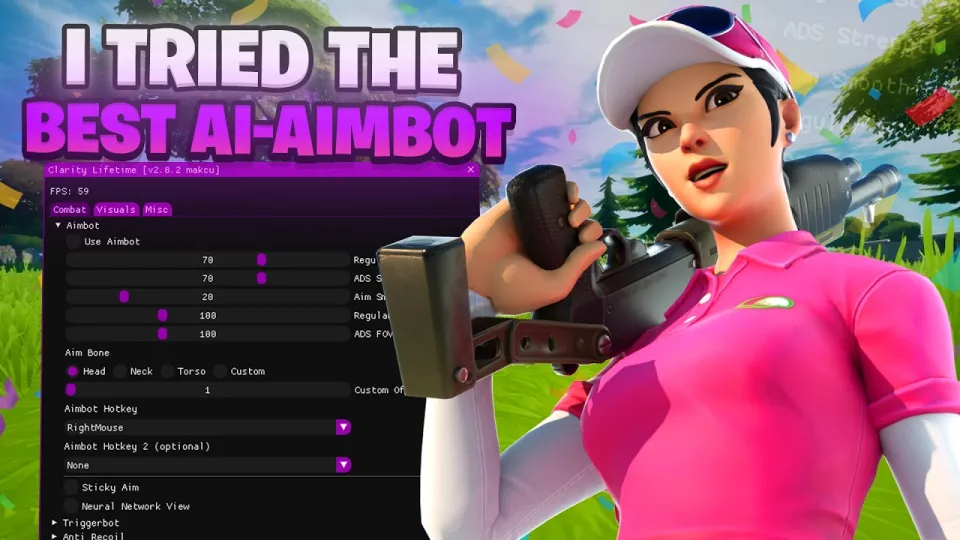
· based on the channel eskiiid
Key takeaways
- Clarity V2.8 is the build shown in eskiiid's breakdown, sold at clarity.moe with a 10% code CLARITY10 and a free version in the Discord.
- AI aimbots read the screen through computer vision instead of reading or writing game memory, which is why they are marketed as undetected.
- The tool needs no hardware: no capture card, no second PC, no modified controller.
- Native controller support is included, so aim assist works with a pad as well as mouse and keyboard.
- The video covers accuracy in real matches, tracking smoothness, FPS impact and setup.
An AI aimbot is an aiming tool that identifies enemies by reading the rendered screen with computer vision models rather than by reading or writing the game's memory. That single design choice is why tools like Clarity V2.8 are marketed as undetected: there is no injected DLL, no memory signature and no driver for an anti-cheat to fingerprint. The build shown in eskiiid's breakdown is distributed through the Clarity Discord, where a free version is available alongside the paid release.
What an AI aimbot actually does differently
A classic aimbot works inside the game process: it reads entity coordinates from memory and writes new angles to your view. An AI aimbot never touches that process. It grabs the frames your GPU has already drawn, runs an object-detection model over them, and converts the detected bounding boxes into mouse or stick movement.
The pipeline is short and worth knowing, because every limitation of these tools comes from it:
- Capture. A screen-capture API (Desktop Duplication or a similar hook) pulls frames at high rate.
- Inference. A detection model trained on player models finds heads and bodies in each frame.
- Target selection. The closest or most central detection is chosen, usually with a field-of-view limit.
- Movement. The offset between the crosshair and the target is translated into relative mouse input or right-stick deflection.
- Smoothing. The movement is spread over several frames so the resulting flick looks human.
Because step 1 only needs pixels, the same build can support Fortnite, Apex Legends, CS2, Rainbow Six Siege, Call of Duty and Rust without per-game offsets. That is the practical advantage: no offset updates after a patch, but also no access to information the screen does not show.
Clarity V2.8: what the build includes
Clarity V2.8 is the version featured in the video, and it combines an AI aimbot with an AI aim assist mode. The assist mode is the more interesting half: instead of snapping to a target, it applies a small corrective pull while you track, which is what most players actually want from an aim assist tool.
Key points from the release:
- No hardware required. No capture card, no second PC, no Arduino or modified controller. It runs on the same machine as the game.
- Native controller support. Aim correction is applied to the right stick, so console-style input works without extra emulation layers.
- Instant delivery. The paid licence is issued automatically after purchase at clarity.moe.
- Pricing code. The code CLARITY10 takes 10% off at checkout.
- Free tier. A limited version is distributed through the Discord server for testing before buying.
The vendor positions the smoothness of the tracking as the headline feature, claiming the output is close to a silent-aim feel while still looking like human input in replays.
How the accuracy test is structured
The showcase is built around real matches rather than scripted clips. eskiiid runs the tool through live games and evaluates four things: how reliably the model locks onto a target, how quickly it re-acquires after a target breaks line of sight, how smooth the on-screen movement looks, and what it costs in frame rate.
When you evaluate any AI aimbot yourself, use the same order:
- Detection rate. Watch for missed enemies at distance and in poor lighting; a vision model degrades faster than a memory reader there.
- Re-acquisition. Strafe-heavy fights expose whether the model keeps a target ID stable or re-detects from scratch every frame.
- Smoothing quality. Fast flicks that stop dead on the head are the classic tell; good smoothing overshoots slightly and corrects.
- Performance cost. Measure average FPS with the tool off and on in the same area of the same map.
- Edge cases. Smoke, flash effects, deployable cover and death animations are where vision-based tools produce false positives.
The undetected claim and what it really means
"You can't get banned" is the phrase in the video title, and it deserves a precise reading. Vision-based aimbots avoid the detection methods that target code inside the game process, which removes the largest category of anti-cheat signatures. It does not make a tool invisible in principle.
What a vision aimbot still leaves behind:
- Input patterns. Anti-cheat systems increasingly analyse mouse movement statistically; perfectly linear correction at a constant rate is anomalous regardless of how it was generated.
- Capture footprint. Screen-capture hooks and overlay windows are visible to some anti-cheat clients.
- Model artefacts. Detection jitter can produce micro-corrections that a human would never make.
- Account-level review. Reports and manual review catch behaviour that automated scans miss.
So the honest framing is that a computer-vision aimbot removes one detection vector, not all of them. Anyone selling an undetected aimbot is describing the current state of a moving target, and the safe assumption is that the state changes.
AI aim assist versus silent aim
Silent aim is the classic high-risk approach: your shots are redirected server-side or through the game's own functions, so on your screen the crosshair never moves. It is powerful and it is exactly what memory scanning is built to find.
An AI aim assist sits at the opposite end. The crosshair visibly moves because the tool is moving your mouse, and the goal is to make that movement indistinguishable from a good player. The trade-off is straightforward: less perfect accuracy, far less surface area for detection. The same logic explains why the smoothness of the tracking gets more attention in the showcase than raw lock-on speed — a tool that snaps instantly is both more suspicious and, in practice, harder to play with.
Setup and performance expectations
Setup for a vision-based aimbot is lighter than for memory-based tools, but it is not zero-config. Expect to tune a field-of-view radius, a smoothing factor, a target-bone preference (head or chest) and a hotkey. Controller users additionally tune stick sensitivity curves so the assist does not fight the game's own aim settings.
On performance: inference on every frame is GPU work. A well-optimised model at a capped capture rate costs a few percent of frame time; an unoptimised one can cost far more. Before committing, run a fixed benchmark route with the overlay disabled and enabled, and compare 1% low frame times rather than average FPS — stutter is what you will feel in a fight. The video includes a performance breakdown covering FPS impact, configuration and setup.
All links from the breakdown
- Free version and community: https://discord.gg/claritymoe
- Clarity V2.8 AI aimbot product page: https://clarity.moe/product/ai-aimbot
Bottom line on AI aimbots
A vision-based aimbot is a genuinely different category from the memory-reading tools that dominated the last decade, and Clarity V2.8 is a clear example of the approach: screen capture, detection model, smoothed mouse or stick output, no hardware and native controller support. The undetected framing is accurate only in the narrow sense that it avoids process-level signatures, so treat smoothness and consistency as the real quality markers when judging any build. For a hands-on look at accuracy, tracking and frame-rate cost in live matches, watch eskiiid's full breakdown, and start with the free version in the Clarity Discord before paying for a licence.
Source: I tried the BEST Ai Aimbot in 2026... (you cant get banned) · Markdown version
Questions & answers
Is an AI aimbot detectable?
It removes the largest detection vector, because it never reads or writes game memory and leaves no injected code for an anti-cheat to scan. It is not invisible in principle: input-pattern analysis, screen-capture hooks and manual review can still flag behaviour. Treat any undetected claim as a statement about current detection methods, not a guarantee.
Does a computer vision aimbot work on console?
Not directly, since it needs to capture frames from the machine running the game and inject mouse or stick input there. Clarity V2.8 includes native controller support, which means it works with a pad on PC rather than on a console itself.
What hardware do I need to run Clarity V2.8?
None beyond the PC you already play on. The build requires no capture card, no second computer and no modified controller, because capture and inference happen on the same machine as the game. Budget some GPU headroom, since running a detection model on every frame costs performance.
How is AI aim assist different from silent aim?
Silent aim redirects your shots so the crosshair never visibly moves, which usually means interacting with the game's own functions and is heavily targeted by anti-cheat. AI aim assist moves your actual mouse or stick input, so the crosshair visibly tracks the target and the goal is to look human. It is less perfect but far less exposed.